Check official Shawnee National Forest pages for current alerts, closures, fees, and trail conditions before you go. This site is not a substitute for Forest Service information.

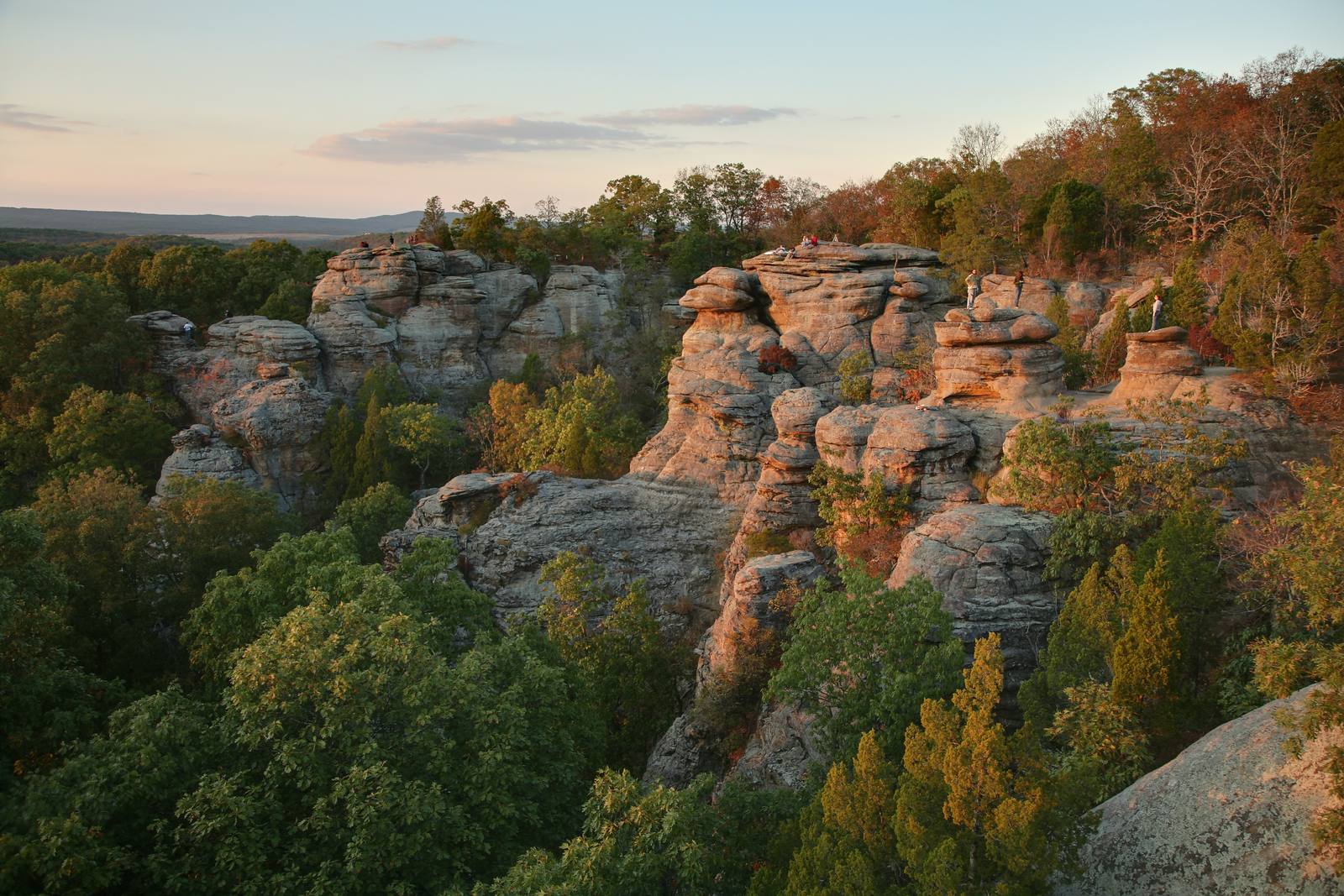
Late-day light on the sandstone bluffs and hoodoos of Garden of the Gods, with a wide view over the Shawnee Hills.

Garden of the Gods

Sandstone cliffs, named rock formations, and one of the best-known views in Illinois, on the eastern side of the Shawnee National Forest.

A landmark of the Shawnee Hills

The Forest Service calls Garden of the Gods one of the most photographed places in the state. The recreation area is a place to hike, camp, watch wildlife, or picnic, with views into the Garden of the Gods Wilderness.

That wilderness was designated by the Illinois Wilderness Act of 1990 and covers about 3,293 acres. No motorized vehicles or mechanized equipment are allowed there. No permit is required to enter or camp in the wilderness, but group size is limited to 10 people, and the usual wilderness and natural-area rules apply.

From Harrisburg, the Forest Service directions are: take Highway 145 south 5 miles to Highway 34, then Highway 34 south for 10 miles, turn east on Karbers Ridge Road for 2.5 miles, then turn north on the forest road and continue 1.5 miles to the recreation area entrance.

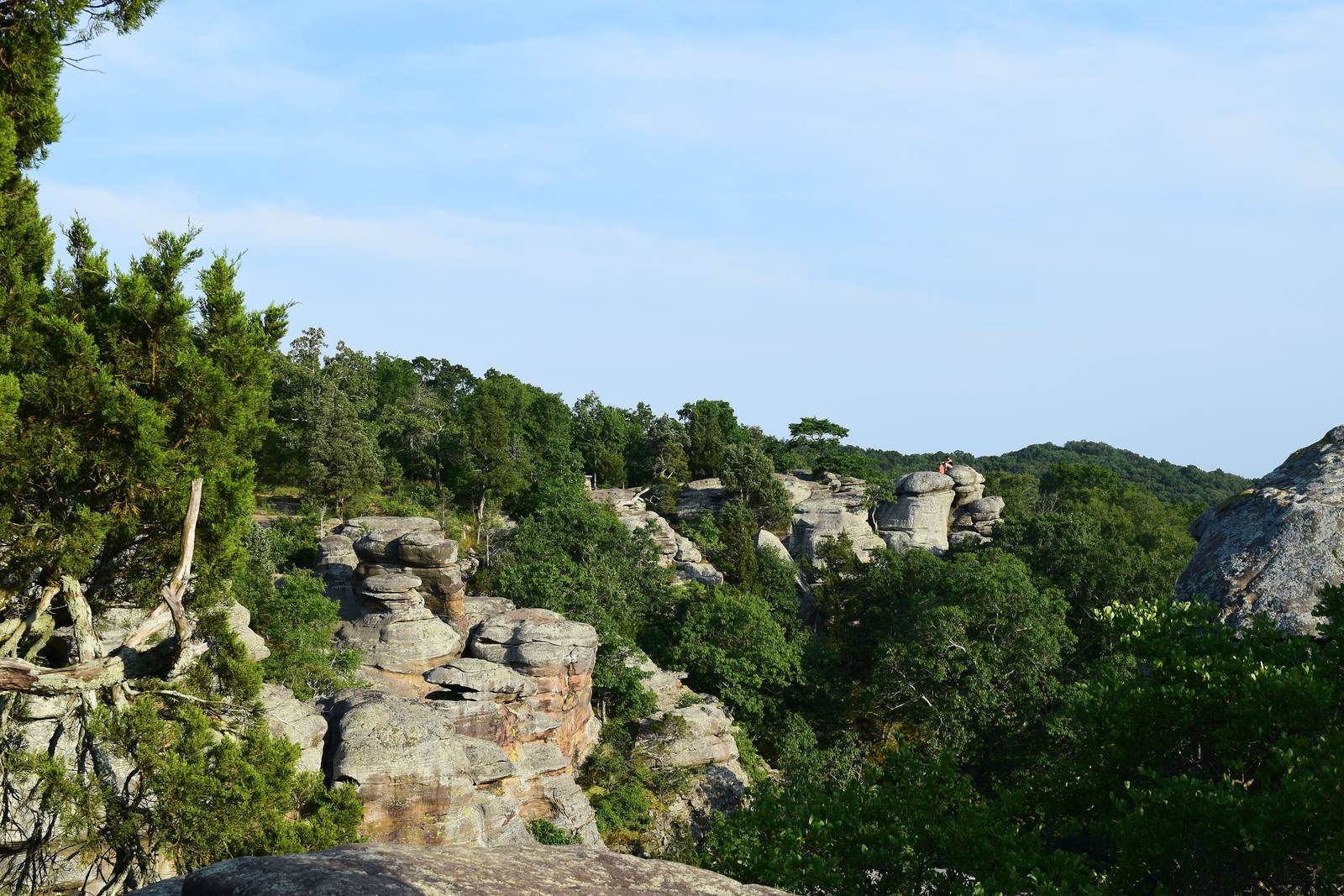
Close view of weathered sandstone formations at Garden of the Gods, with junipers and summer forest.
Photo: TheCatalyst31, CC BY-SA 4.0, via Wikimedia Commons. Resized for this site.

How the rocks formed

The cliffs and formations are made of Pennsylvanian-age Pounds Sandstone, part of the Caseyville Formation, and are about 320 million years old. The Illinois State Geological Survey and Forest Service interpretive material describe a long period when much of the region lay under a shallow inland sea. Rivers carried sand and mud to the shoreline. Those sediments were buried, hardened into rock, later lifted and fractured, and then worn by rain, wind, and freeze-thaw into the shapes visitors see today.

Interpretive signs along the Observation Trail explain this history on site. Named formations include Camel Rock, Table Rock, and Devil’s Smokestack. The recreation area sits on the south limb of the Eagle Valley Syncline, in one of the more rugged and geologically complex parts of Illinois.

The Observation Trail

The main walk is a quarter-mile interpretive trail of natural sandstone. The Forest Service says it takes about an hour, with short, steep grades and a few steps, and that the trail as a whole is not tiring. Benches are placed along the way. Hours for the picnic area and Observation Trail are 6:00 a.m. to 10:00 p.m.

There are three large parking lots at the trail. Overflow parking is at the Golden Circle Trailhead just outside the recreation area. Overnight parking is not allowed in the picnic or Observation Trail lots; use the backpacker’s parking lot at the Indian Point Trailhead, or nearby trailheads such as Hitching Post and Golden Circle.

High cliffs are the main hazard. Stay on the designated trail. Disposable food and beverage containers are not permitted on the Observation Trail. Pets must be leashed. There is no water at the trailhead; potable water is available at Pharaoh Campground. Vault toilets are provided. Cell coverage is often weak or missing, and emergency response can take longer than in town.

Hiker-only trails in the area include the Observation Trail, Indian Point Trail, parts of Anvil Rock Trail, and Trail #108H. The River to River Trail, marked with a blue letter “i,” also passes through the area. Trail details
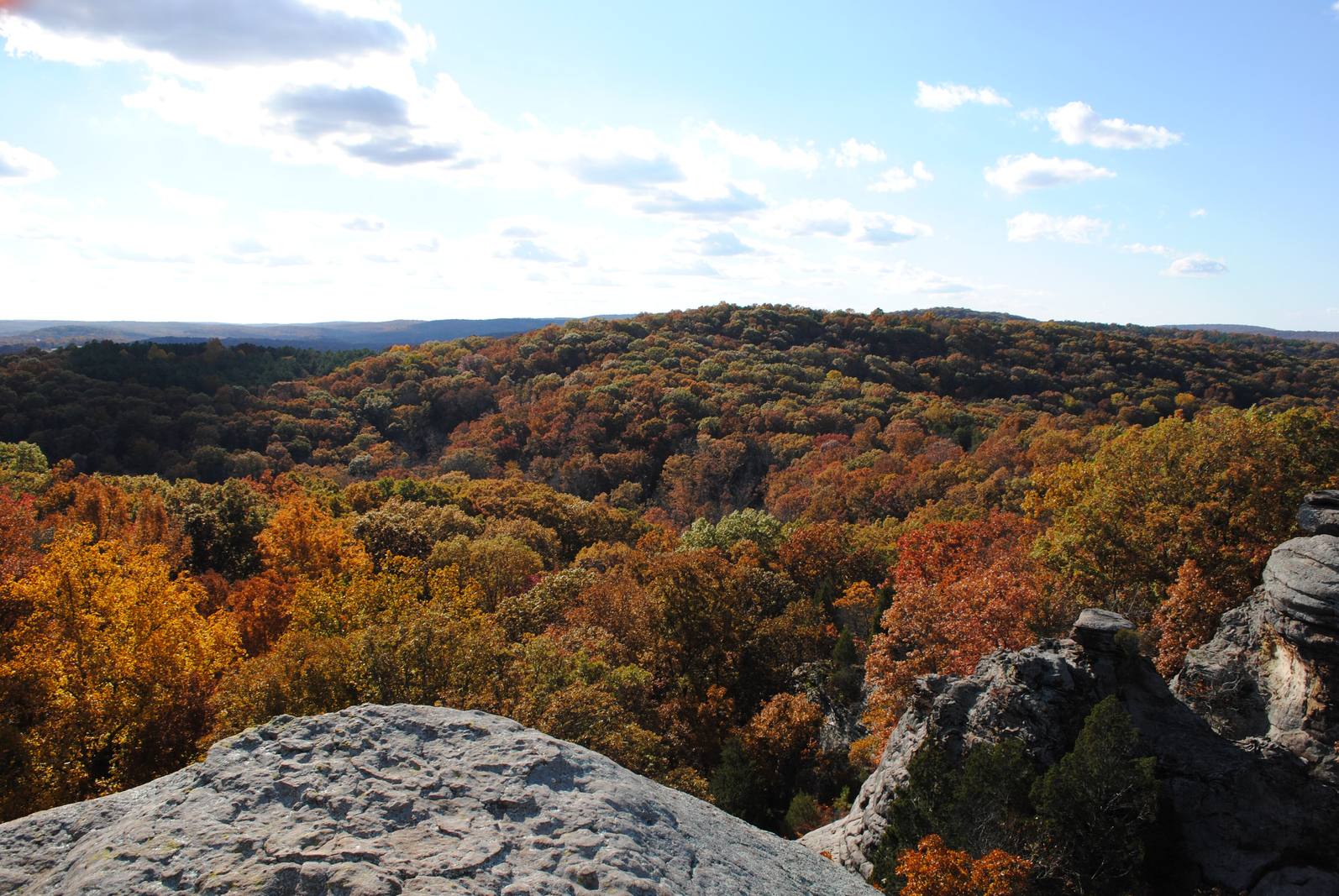
Autumn forest stretching to the horizon, seen from a sandstone ledge at Garden of the Gods.
Photo: USDA Forest Service, public domain, via Wikimedia Commons. Resized for this site.

When to visit

The Observation Area and Pharaoh Campground are open year-round. The Forest Service says spring brings wildflowers and rushing streams, while autumn brings strong fall color and fewer insects. Little Grand Canyon, not far to the west, is also called out as especially beautiful in April and October.

Because this is a well-known overlook with limited parking, arriving when the area opens, or on a weekday, is often more comfortable. After rain or in winter, sandstone steps and bluff edges can be slick. Check the official page for closures or parking changes before you go.

Photography notes

The Forest Service itself points to the “painted sunset sky” at Garden of the Gods, and late-day light on the sandstone is a classic view. The official hours (6:00 a.m. to 10:00 p.m.) also allow early light. Stay well back from cliff edges, and do not leave the trail or climb on the formations for a picture.

Leave rocks and plants as you find them. Disposable food and drink containers are not allowed on the Observation Trail, so pack cameras and snacks accordingly. A wide view of the hills is part of the scene; the fall-color overlooks are worth a slower walk as well as a single sunset shot.

Pharaoh Campground

The recreation area’s developed campground has 12 sites and is open year-round. Sites include tables and fire grills, with toilets, drinking water, and access to nearby trails. The fee published on the official page is $10 per night, with a maximum of eight people and two vehicles, paid in cash or check. Camp only at designated sites. The picnic ground is also open year-round and offers views of the Shawnee Hills.

Pounds Hollow Recreation Area, about six miles east, has a larger campground if Pharaoh is full. For wilderness travel, the Forest Service encourages detailed maps, and overnight parking is allowed at the backpacker’s lot. Poison ivy and venomous snakes are present. Carry water, food, and a first-aid kit on longer hikes. Campground details

Official Garden of the Gods page Wilderness information

Hero photo: Daniel Schwen, CC BY-SA 4.0, via Wikimedia Commons. Resized for this site.